Google Rankings vs AI Citations: Lessons from CentrumAudit.hu
Google Rankings vs AI Citations: key lessons from CentrumAudit.hu on how to succeed in both traditional search and generative AI visibility.
ARTIFICIAL INTELLIGENCE
Video Guru
6/29/20265 min read
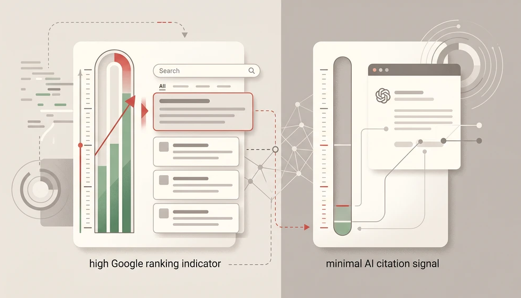
Strong Google rankings do not automatically produce AI citations because the two systems evaluate content through fundamentally different mechanisms. Conventional Google ranking uses relevance, authority, and engagement signals to order results for keyword queries. AI citation systems select sources based on definitional clarity, entity coverage, structured relationships, and citation-friendly formatting. CentrumAudit.hu demonstrates this gap precisely: position 1 for "könyvelés árak" and "könyvelési díjak," yet an AI Visibility Score of 0 and zero AI mentions.
What Position 1 Actually Means in 2026
Holding position 1 in Google organic search for a commercial keyword remains a significant achievement. For CentrumAudit.hu, the top spot for "könyvelés árak" (bookkeeping prices) and "könyvelési díjak" (bookkeeping fees) reflects sustained SEO investment: calculator tools satisfying transactional intent, pricing-transparent service pages, and roughly 12,700 backlinks from 96 referring domains signaling domain authority.
But position 1 does not guarantee traffic growth. Centrum Audit's organic traffic estimate stands at 475, an 11% decline despite improved rankings on its most valuable keywords. This apparent contradiction illustrates a reality many SEO practitioners recognize: estimated traffic reflects keyword volume fluctuations, SERP feature displacement, and seasonal behavior — not ranking position alone. The firm also improved from position 11 to position 3 for "könyvelés" (bookkeeping), an 8-place jump on a high-competition head term. Combined with dual position-one rankings, this gives Centrum Audit a 94.8% Organic SERP Share. In conventional SEO terms, the site performs exceptionally well.
How AI Citations Differ from Rankings
AI citations operate through a selection mechanism that overlaps only partially with ranking signals. When Google's AI Overviews, ChatGPT, Claude, or Perplexity assemble responses, they draw from sources selected during training or retrieved through search grounding. The criteria differ from organic ranking factors in several critical respects.
First, AI systems prioritize definitional completeness — pages that clearly define concepts, explain entity relationships, and structure information for extraction. Second, they favor content breadth: multi-aspect topic coverage with substantive depth over pages hyper-optimized for a single keyword. Third, AI systems consider external citation signals including knowledge base presence and structured data repository inclusion. Finally, Your Money Your Life (YMYL) content — including accounting, legal, and financial topics — faces heightened scrutiny. AI systems may avoid citing commercial sources lacking explicit trust signals even when those sources rank well organically.
The Gap Analysis: Four Dimensions of Divergence
The following table breaks down how Google rankings and AI citations diverge across the dimensions that matter most for professional service firms.
The divergence reflects different optimization objectives. Google's ranking system answers "which page should a searcher click?" AI citation systems answer "which source should I reference when synthesizing an answer?" Content optimized for only one will underperform in the other.
Why Centrum Audit Has Near-Zero AI Visibility
With the divergence framework in mind, the reasons for Centrum Audit's AI Visibility Score of 0 become clearer. The site achieves organic dominance through mechanisms that do not fully overlap with what AI citation systems prioritize.
Limited Content Breadth
Centrum Audit's ranking strength concentrates on pricing and service pages optimized for transactional queries. This narrow topical focus means fewer pages define broader accounting concepts, explain regulatory frameworks, or provide comprehensive educational content that AI systems favor. The 116 ranked keywords indicate solid coverage but not the broad topical authority that signals citation-worthiness.
Few External Citations as a Knowledge Source
With 96 referring domains and an Authority Score of 10, Centrum Audit occupies a mid-tier position. AI citation systems may weight sources appearing frequently in governmental or industry-cited contexts more heavily. A site that ranks well regionally but lacks broader knowledge-graph presence faces a citation ceiling regardless of SERP position.
Narrow Entity Signals
Entity optimization — structured expression of concepts, organizations, and relationships that semantic systems parse — differs from keyword optimization. Pages using a keyword repeatedly may rank well without clearly signaling to AI systems which entities they describe and how those entities relate. Calculator tools, while excellent for user engagement, provide limited entity relationship data.
YMYL Sensitivity for Accounting Content
Accounting falls squarely within YMYL. AI systems handling financial queries apply conservative citation policies, preferring governmental sources, established financial institutions, or educational resources over commercial providers. This filtering mechanism helps explain why commercial accounting sites underperform in AI citations relative to organic position.
From Rankings to Citations: A Practical Path
The gap between rankings and AI citations is bridgeable. Centrum Audit — and firms in similar positions — can extend existing SEO strengths into AI visibility through targeted adjustments:
Expand definitional and educational content. Publish comprehensive guides defining accounting concepts and explaining regulatory requirements. Go beyond service descriptions to create reference-quality resources with the breadth AI citation systems seek.
Implement structured data markup. FAQ schema, HowTo schema, and Organization markup provide parseable structure that helps AI systems identify claim-worthy passages. Structured data directly supports content extractability for AI synthesis.
Build citation-worthy page structures. Organize pages with clear headings, explicit definitions, sourced statistics, and referenced claims. Each major section should function as a self-contained passage extractable without losing meaning.
Develop broader topical authority. Expand from pricing-focused content to cover accounting methodology, regulatory updates, tax planning guidance, and industry-specific compliance. This builds the entity network signaling topical authority to AI systems.
Strengthen author and organization entity signals. Explicit author bios, professional credentials, linked organization profiles, and consistent entity representation across platforms help AI systems verify source trustworthiness for YMYL content.
Broader Implications for Professional Service Firms
Centrum Audit's pattern is not unique. Across legal, financial, consulting, insurance, and technical service sectors, firms that invested heavily in conventional SEO now find themselves ranking well but cited rarely. The divergence creates a strategic exposure: as AI-generated answers occupy more prominent positions in search interfaces, firms dependent solely on organic rankings may see effective visibility decline even while position-tracking reports remain stable.
▶ Key Insight
Conventional Google rankings and AI citation visibility measure different capabilities: rankings reflect a page's ability to attract clicks for keyword queries, while AI citations reflect a source's suitability for inclusion in synthesized responses. A site may dominate organic SERPs through relevance and authority signals yet remain invisible to AI systems if its content lacks definitional clarity, structured entity relationships, or citation-friendly formatting.
This interpretation is based on observed data patterns, not verified causal statements from platform documentation. The mechanisms underlying AI citation selection remain partially opaque and evolve continuously. What the data confirms unambiguously is that the correlation between organic ranking position and AI citation frequency is weaker than many practitioners assume.
▶ Evidence
Confirmed: Centrum Audit ranks position 1 for "könyvelés árak" and "könyvelési díjak" with an AI Visibility Score of 0 and 0 AI Mentions. Only 1 page across the domain has been AI-cited.
Suggested (interpretation): The divergence between 94.8% organic SERP share and zero AI visibility indicates that ranking optimization and citation optimization require distinct strategies.
Not established: Whether AI citation visibility will drive comparable traffic volumes to organic rankings, or whether firms should prioritize one over the other.
Diagnostic Checklist: Assessing Your Rankings-vs-Citations Gap
Use these six questions to evaluate whether your firm may be experiencing the same divergence observed at Centrum Audit. Three or more affirmative answers indicate a significant gap.
Firms answering affirmatively to multiple questions should consider an AI visibility audit to identify specific gaps between their current strategy and what AI citation systems require.
Methodology note: All ranking data, traffic estimates, and AI visibility metrics are sourced from SEMrush, a third-party SEO analytics platform. These figures are estimates derived from SEMrush's keyword databases and click-through models — not official Google data. Actual traffic, ranking positions, and AI citation frequencies may differ. The SEMrush snapshot date is June 27, 2026.
Frequently Asked Questions
Sources
1. CentrumAudit.hu — Hungarian accounting firm website analyzed in this case study.
2. SEMrush traffic and ranking data snapshot, June 27, 2026 — third-party estimates for all performance figures cited.
3. Roth AI Consulting Case Studies — additional case studies on AI visibility gaps in professional service firms.
4. Google Search Central Documentation — Structured Data Guidelines (FAQ and HowTo schema references).
Assess your rankings-to-citations gap with an AI visibility audit.